WOODEN FURNITURE & HOME
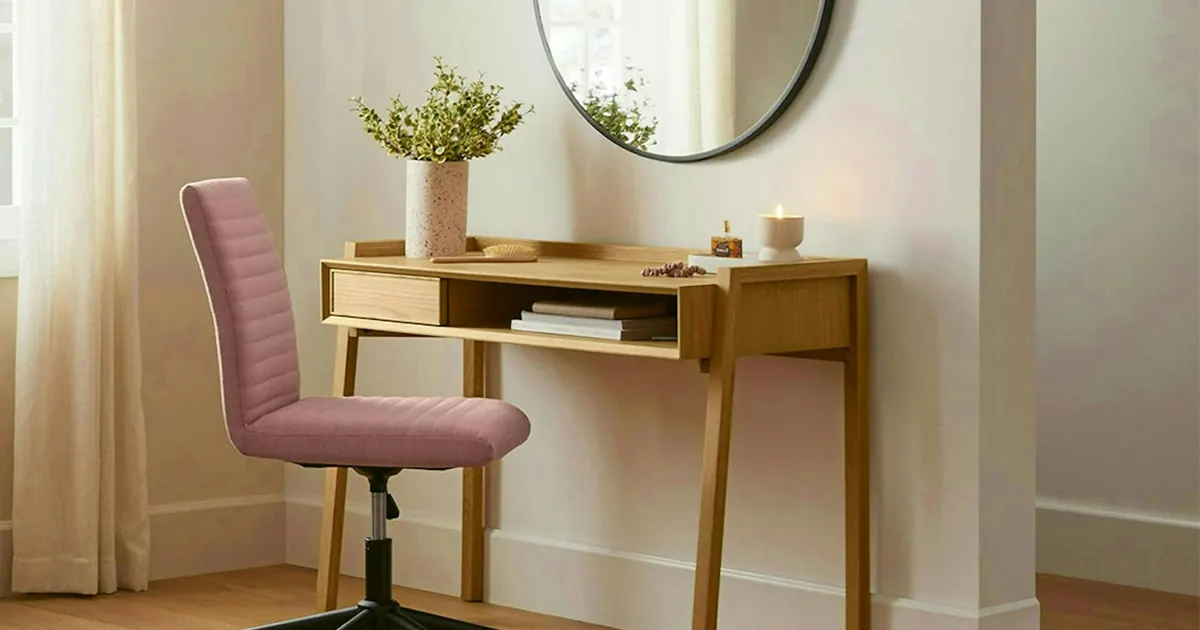
Wood desks for small spaces need room for the person using them as well as the desk itself. Choose the footprint around your work gear, an occupied chair and the route past it; a narrow top alone won’t tell you whether a desk fits. The tricky part is often the floor in front of the drawer, or the space a chair needs when you stand up.
Measure the desk wall beyond the empty gap
A desk can fit between nearby furniture yet still sit farther from the wall than expected when baseboards, plugs or cable bends hold its back edge away from the wall and push its front edge into the room. A nearby door may also swing through what looked like free floor space. Those details belong in the layout before a desk goes on the shortlist.
Measure the usable wall width at the proposed desk position, then mark the depth on the floor with removable tape or paper. Include any gap needed behind the desk for the outlet and connected plugs. Open nearby doors and drawers with that outline in place; the desk’s front edge should be judged against the room as it is used.
For a bedroom corner, pay particular attention to the route between the desk and the bed. A desk beside the bed may leave a useful wall free, but a chair pulled into that route changes the arrangement. The wood furniture guide applies the same footprint-and-route check to the other pieces sharing the room.
Compare desk width and depth as separate choices
Once the wall position works, desk width and desktop depth answer different questions. Width controls how far the desk runs along the wall. Depth controls how far it projects into the room and how much front-to-back room remains for the things on top.
Two product listings show why “small desk” isn’t a single size:
| Product example | Listed width × depth × height | Construction described by the seller |
|---|---|---|
| Snyder’s Amish Writing/Computer Desk | 32 × 18 × 30 in | Solid hardwood |
| Article Fantol Natural Oak Desk | 43.25 × 18 × 31 in | Solid oak, engineered wood and oak veneer |
These are the sellers’ published dimensions, used here as comparison examples. Both desks have the same listed depth, but the Fantol needs more wall width. Its wood appearance also doesn’t make it an all-solid-wood desk: Article lists a mix of materials.
The Snyder’s example below shows a narrow writing desk with a drawer beneath the top and a low stretcher between the legs. A compact top can still come with details underneath that matter to where your feet and chair will go.
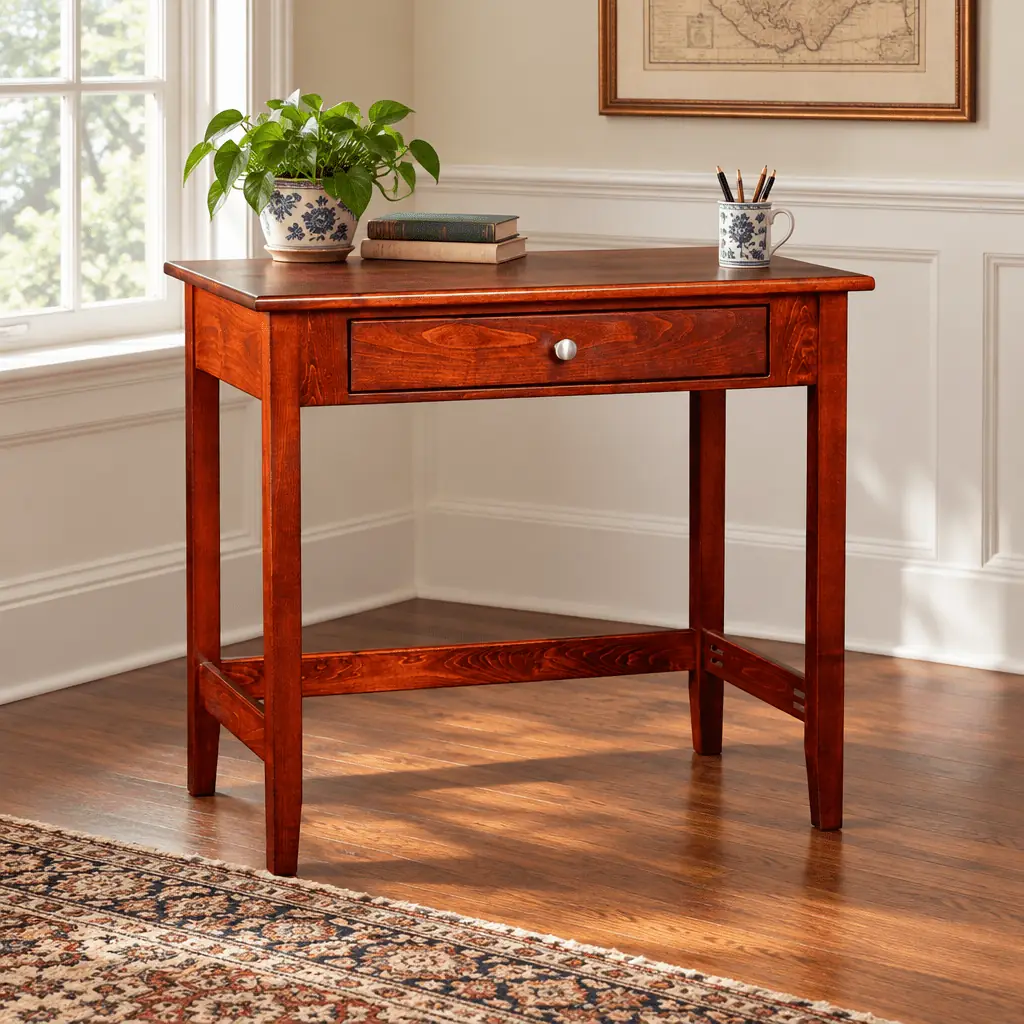
Use the dimensions to rule out poor fits, then check the remaining details. Neither listing establishes how either desk will feel with your chair, computer and everyday working position. These are catalog examples, not desks tested by Wood Center.
Lay out the computer before accepting a shallow top
An appealing depth on the floor plan still has to hold the work you do. A laptop used on its own leaves a different arrangement from a screen, separate keyboard, mouse and open notebook. A lamp base and charging cables need somewhere to sit too.
Mark the shortlisted desktop’s width and depth on a table or a sheet of paper, then place your actual equipment inside that boundary. Include the laptop with its screen open, the mouse movement you use and the notebook in its working position. A photograph of a nearly empty desk can’t answer that test.
Pay attention to what gets displaced when you start working. If the notebook has to cover the keyboard, or the lamp occupies the mouse area, decide which item can move elsewhere before choosing the desk. A shelf may hold books; it won’t add the desktop space needed for an open book beside a computer.
For a laptop-only corner, a shallow writing desk may suit the task. For a permanent computer setup, the same footprint deserves a closer trial. Buying the shortest top available can save wall space while leaving the actual work spread across the room.
Count the open drawer in the desk footprint
Once the equipment fits, look below the top. A drawer can keep pens and small supplies off the desktop, but it also extends into the space in front of the desk when opened. An open cubby offers a different access pattern, with its contents visible and reachable from the front.
The Fantol detail below makes that distinction clear: the drawer projects beyond the front edge, while the neighboring cubby stays within the desk body.
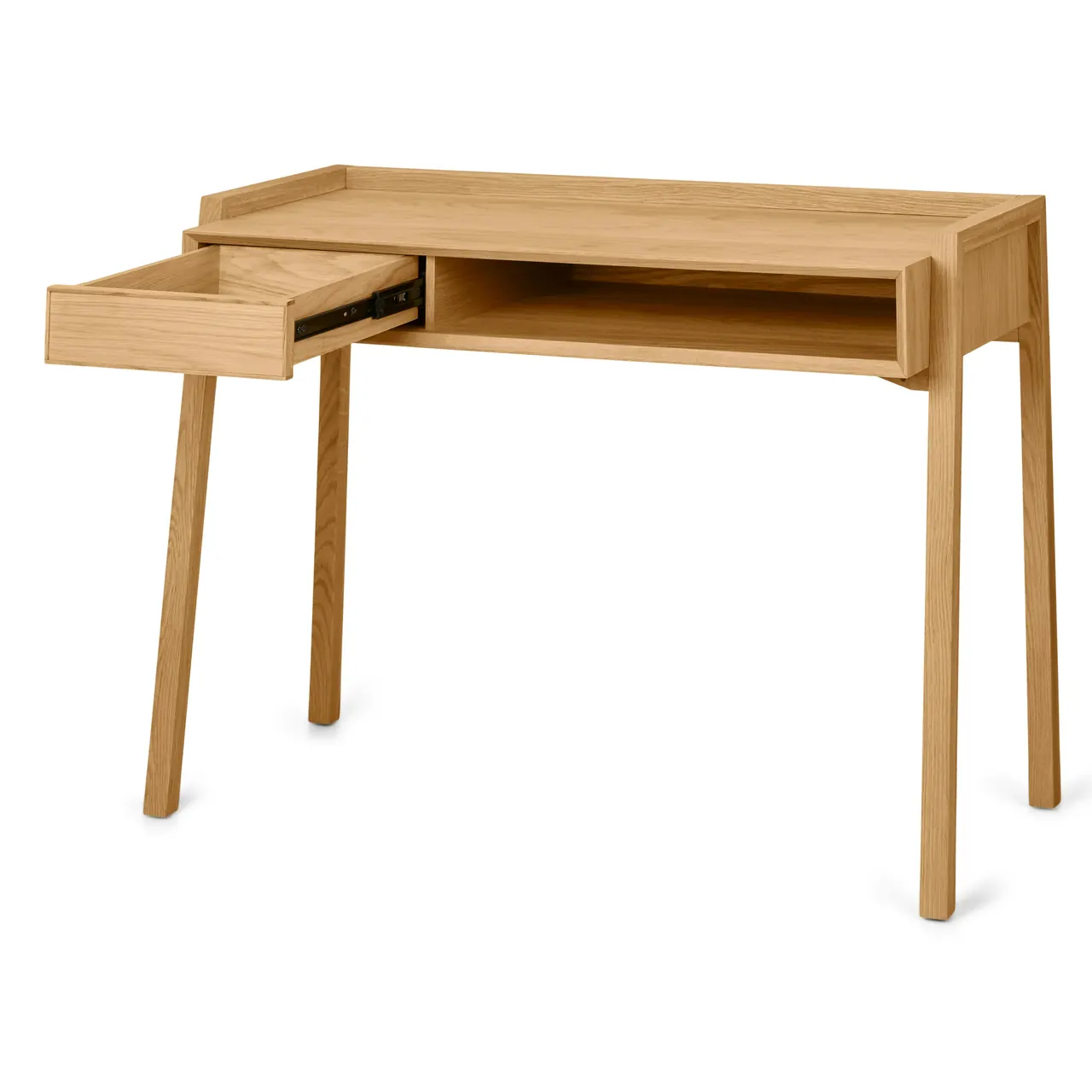
Ask for the open drawer projection if it isn’t in the listing, and include it in the layout. Check whether you can reach the drawer from your usual seat or whether the chair must move first. A drawer that’s awkward to open tends to lose its value as everyday storage.
Storage beneath the top also needs to leave usable space for your legs. Overall desk height describes the outside of the piece; it doesn’t describe the opening beneath a drawer or apron. Look for the under-desk clearance and the opening between the legs when comparing the remaining candidates.
Try the chair through a whole working session’s movements
Drawer access is only part of the moving space. Your chair needs to approach the desk, sit in a useful working position and pull back far enough for you to stand. A chair shown in a catalog scene demonstrates an arrangement, without proving those movements in another room.
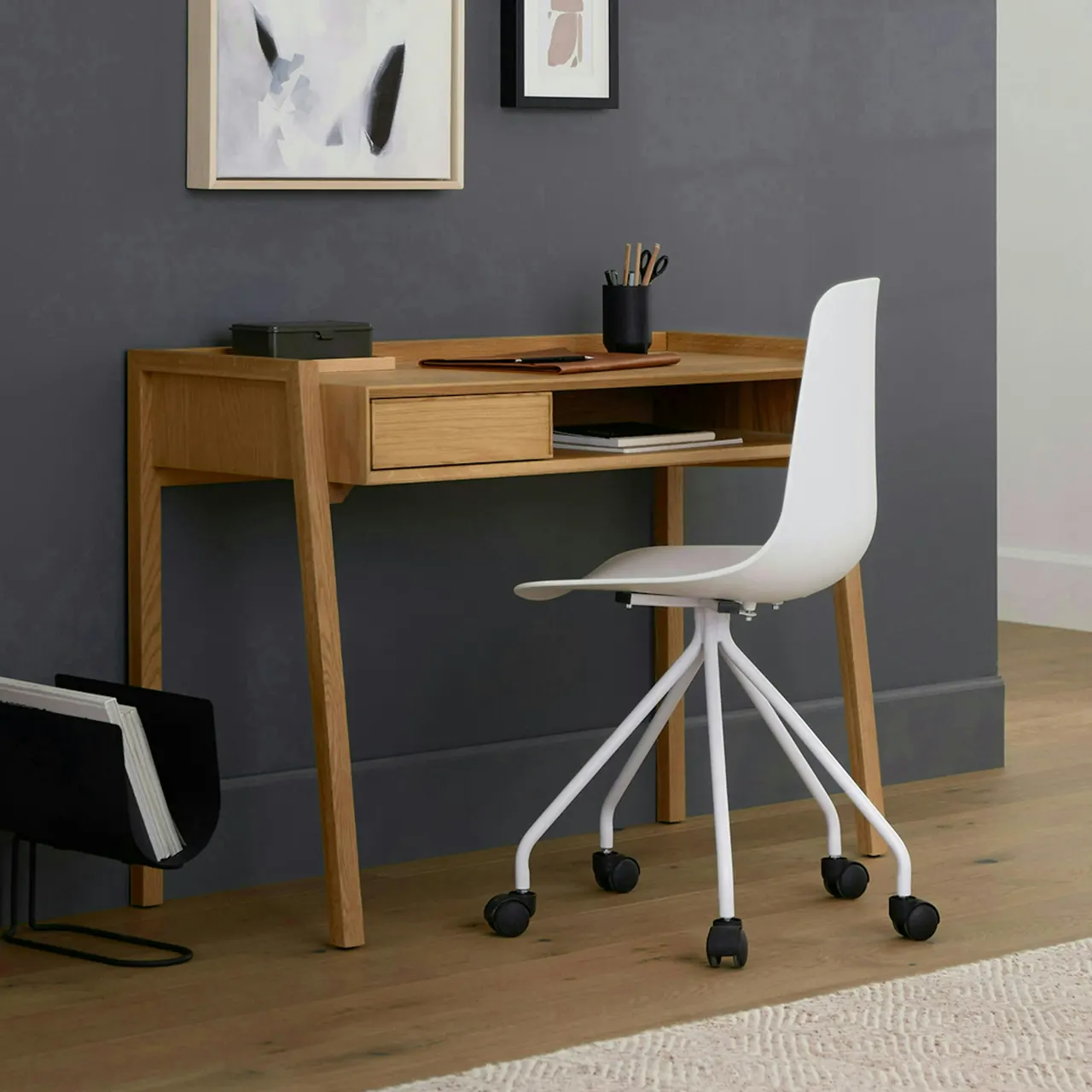
Put your chair at the marked desk position and sit as you would to work. Roll or slide back, stand up, and walk through the nearby route. Try any arms against the proposed underside height, and check the chair base against the desk legs; the seat width alone won’t describe either fit.
If the desk will share a living room, consider the view from the sofa as well. A screen may help the work area recede after hours, but its footprint also needs room. The guide to wood room dividers for small spaces explains the difference between a fixed slat boundary and a folding screen that needs a storage spot.
Choose the wood finish after the desk layout works
With the working space settled, the finish becomes easier to judge against the room. Compare the desk with the floor and the nearest large piece of furniture. A pale desk, a darker writing table and a mixed-material desk can each fit a small room; color can’t recover space lost to a blocked drawer or chair.
Read the material description alongside the care instructions: “oak” in a product name may describe a combination that includes veneer and engineered wood, as it does for the Fantol example. If solid hardwood is a requirement, confirm the construction of the specific model rather than relying on grain in the photograph.
Keep the final shortlist beside your marked layout and equipment trial. The useful choice is the desk that holds the work, opens where it needs to and lets you leave the chair without rearranging the room.