WOODEN FURNITURE & HOME
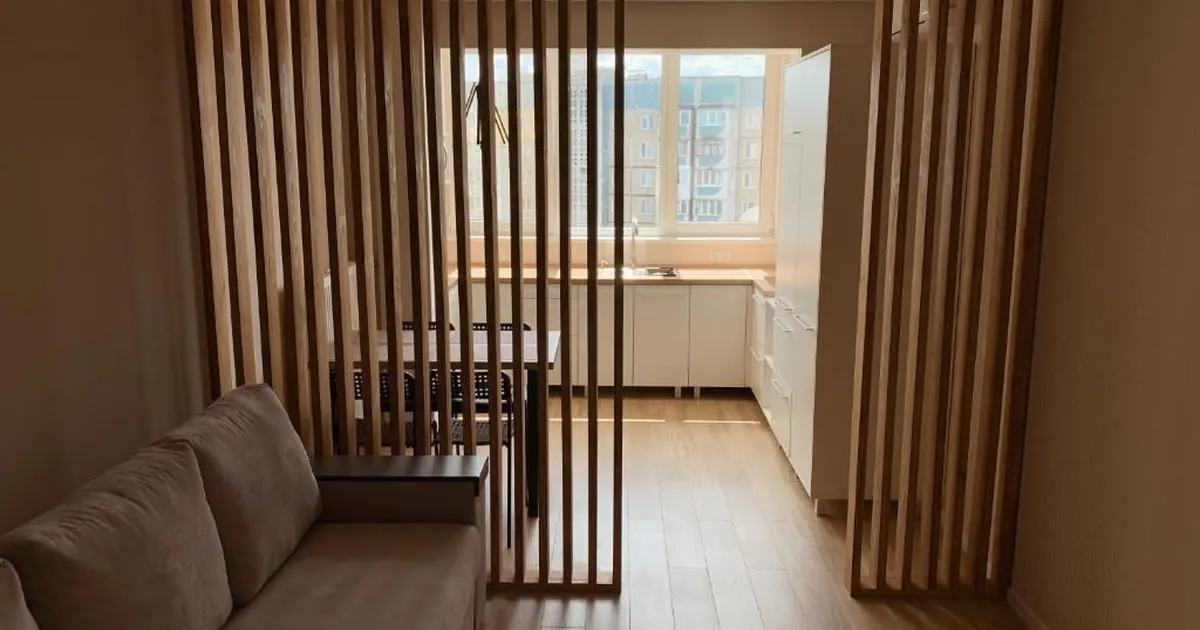
Wood room dividers for small spaces work best when they screen a specific view without taking over the route through the room. Choose open slats to mark a lasting boundary while keeping views between zones; consider a folding screen when the boundary needs to move. The deciding detail is often the space around the divider, including where a folded screen will live.
Open wood slats separate zones without closing the view
An open slat partition suits a room where the bed, sofa or desk should feel like a separate zone but doesn’t need a solid visual barrier. The gaps remain part of the design: objects and movement can still be visible through them.
In the compact apartment below, a tall wood partition follows the sofa back and marks the edge of the sleeping area. The bed remains visible beyond the slats, which makes the tradeoff easy to judge: a clear boundary, with limited visual privacy.
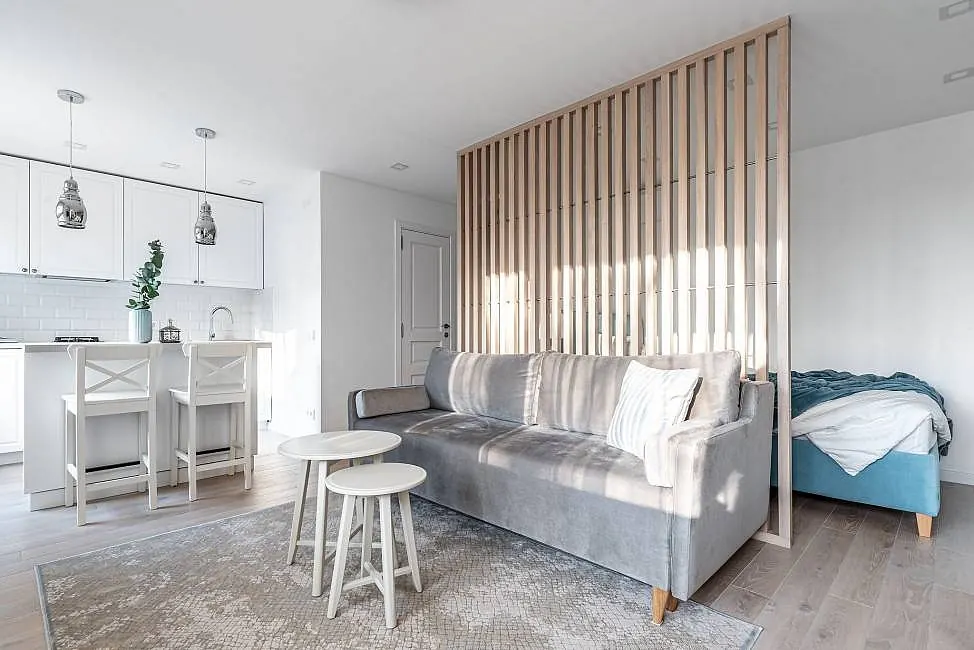
Start with the furniture edge the divider should follow. Don’t extend it past the sofa or bed unless there’s room to walk around its end.
A fixed partition won’t fold away when the room needs to change. Before choosing one, check the proposed attachment method with the supplier and, where relevant, the property owner; the photograph doesn’t establish a suitable mounting method for another home.
The wood furniture guide connects each furniture footprint with the route through the whole room, a useful starting point before adding a fixed boundary.
Folding wood screens need room for their angles
A folding screen can hide a desk after work or a bed when guests visit. You can move the boundary when you don’t need it, but its angled panels still take up floor space.
The screen below has six hinged panels and white inserts within a wood frame. Unlike the open slats above, those inserts interrupt the direct view through the panel faces; privacy around the edges and any silhouettes still depend on placement and lighting.
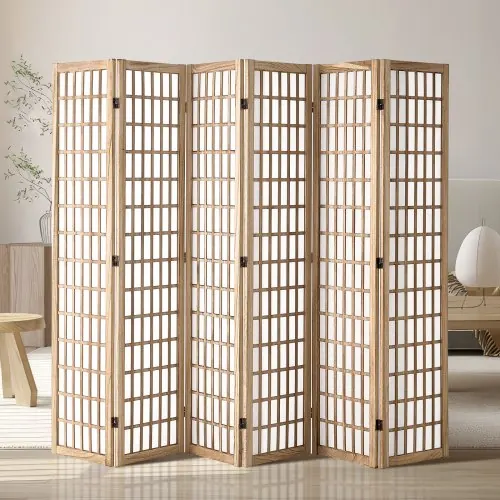
When comparing models, look for the dimensions in the intended standing arrangement as well as the folded dimensions. Don’t assume a width advertised for a fully extended screen describes how much view it will cover when angled.
Follow the selected screen’s setup instructions rather than flattening its panels to gain more coverage. For a small room, a workable storage spot matters just as much: a folded screen leaning in the only usable corner can simply move the obstruction elsewhere.
Place the divider across the unwanted sightline
Once the divider type is clear, choose its position from the view that needs screening. A bed visible from the entrance calls for a different boundary from a desk visible behind the sofa during a video call.
Stand at the entrance, then sit in the chair or on the sofa where the view matters. Consider what the divider hides from each position and what remains visible above, beside or through it; standing privacy and seated privacy can be quite different.
The apartment below places an open partition along the side of the sleeping area, leaving a route beside it toward the kitchen. The useful detail is the relationship between the bed edge, the partition and that route, rather than any dimension inferred from the photograph.
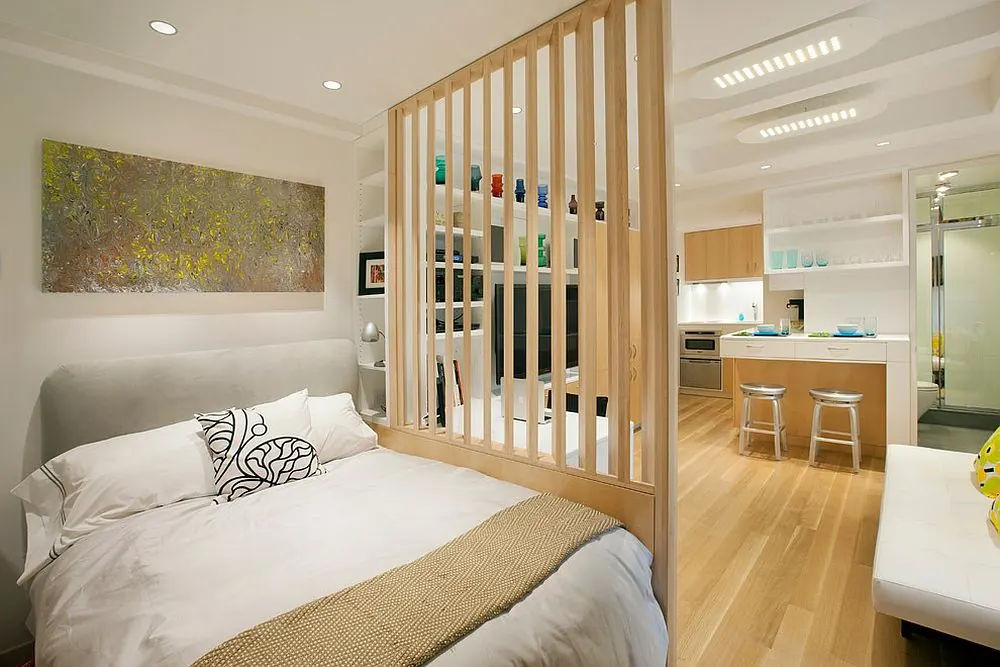
The shortest divider that blocks the unwanted view is a useful starting point for a layout sketch. Extending it across the entire room may hide more, but it also creates a longer barrier to walk around.
Check daylight and daily movement before choosing a size
A promising sightline can still produce an awkward room if the divider sits between the window and the area used during the day. Open slats leave gaps for light, while solid or translucent inserts change what passes through; neither a bright product photo nor a pale wood finish establishes the result in your room.
Compare the proposed position from both sides with the room’s usual lights on and off. If the goal is privacy, include the evening arrangement, when the screened area may be brighter than the space outside it.
On a floor-plan sketch, show the divider’s full footprint, including panel angles or projecting feet. Then check the routes from the entrance to the bed, seating and kitchen, along with the space needed to open doors and pull out chairs.
Where a divider sits near a dining area, use the table in its everyday configuration when judging the route. A small-space wood dining table may fit with chairs tucked in yet need more room once someone sits down.
For an open slat partition, compare the view looking straight through the gaps with the view from an angle. For a folding screen, include the space needed to move it between its standing position and storage spot.
Let the wood divider share the room’s palette
After the boundary works, choose the wood tone against the floor and the largest nearby furniture. A tall divider occupies a large part of the view, so its color deserves the same attention as a table or cabinet.
A light frame can echo a pale floor, while a darker frame creates a stronger outline around the separate zone. Either approach can work; mixing wood tones is easier when the divider repeats an undertone already present rather than introducing another unrelated finish.
Keep the divider’s job clear when making the final choice. Open slats suit a visible connection between zones; an insert-filled folding screen suits a boundary that changes during the day. Pick the arrangement that screens the intended view while leaving the room comfortable to move through.