WOODEN FURNITURE & HOME
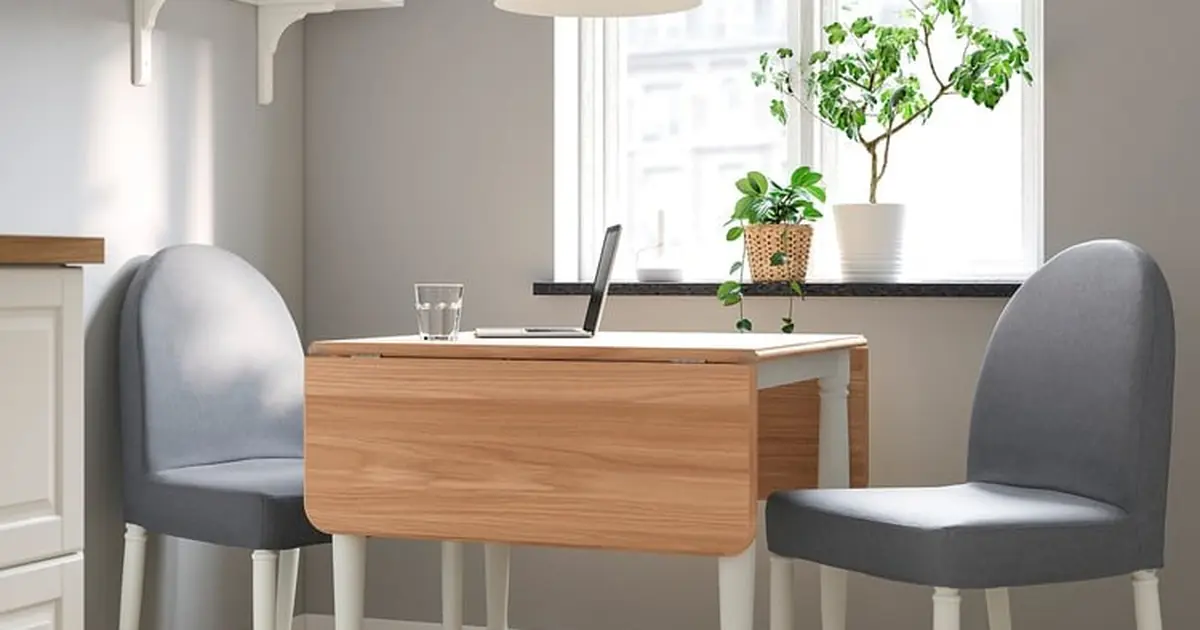
Wood dining tables for small spaces need to fit between meals as well as during dinner. Choose a drop-leaf table when folding the top will reclaim useful floor space, a compact round table when the same seating arrangement can stay out, or an extendable table when guests need occasional extra surface. Compare each with the chairs in place and the table fully open before choosing.
Match the dining table format to the space you need back
Start with what the dining area becomes after breakfast. A table beside a kitchen cabinet may need to shrink so a drawer can open; a dedicated nook may have no reason to change size at all. Paying for a moving top makes sense when its smaller state solves an actual problem.
| Table format | When to consider it | The compromise to check |
|---|---|---|
| Drop-leaf | The tabletop needs to become smaller between meals | A hanging leaf or its support may occupy the space where a chair would tuck in |
| Fixed round | Everyday seats can stay in the same positions | The diameter stays the same, even when the chairs are moved away |
| Extendable | The everyday top works, but occasional meals need more surface | Opening space, leaf storage and extra chairs still need a home |
The useful comparison is the floor area you can actually recover. A folded top gains little if the chairs must remain beside it in the same narrow passage. Keep the chair parking position on the plan from the beginning.
For a dining area sharing a living room, the wood furniture guide connects individual furniture footprints with the route through the whole room.
A drop-leaf table must work with the leaves down
A drop-leaf table changes the top by lowering hinged sections at its edges. Before comparing the fully open dimensions, decide which edges will be used for everyday seating and which will face a wall or passage. The lowered panels and their supports belong in that decision.
IKEA lists the DANDERYD example at a minimum length of 29 1/8 inches and a maximum of 52 3/4 inches, with a width of 31 1/2 inches. Its product description allows no leaves, one leaf or both leaves raised. Those are model-specific configurations; another drop-leaf table may fold along a different axis.
The room view below shows a leaf hanging beside the seated area. That panel is worth looking at closely when deciding where the unused chairs will go.
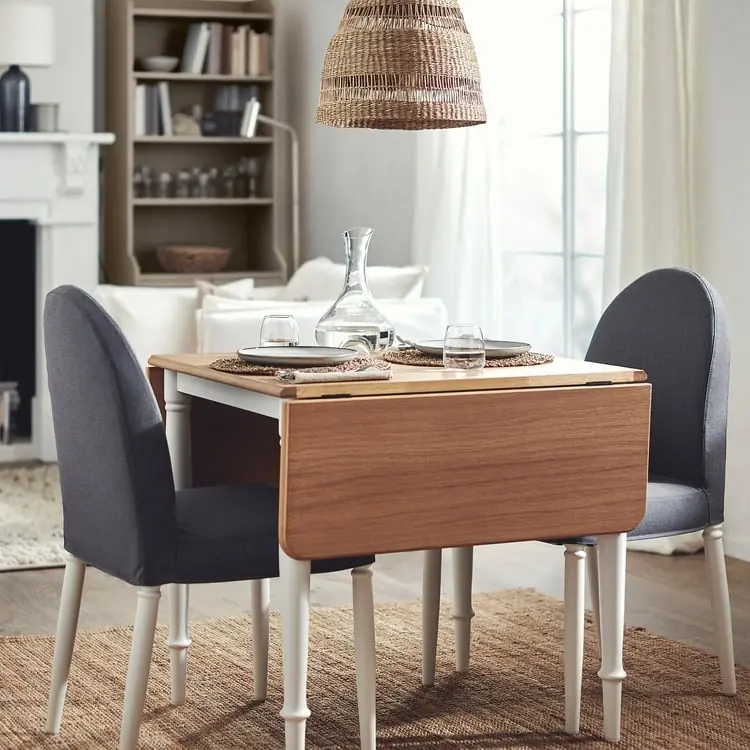
Ask to see the underside in the configurations you expect to use. Does the support swing into the chair space? Can the chair move beneath the fixed portion of the top? Where will you stand to raise a leaf when the table is beside the wall? Follow the chosen table’s instructions for its supports and locks.
Also read the construction description. The pictured model has an oak-veneer tabletop and steel legs; its white turned-leg appearance does not make it an all-solid-wood table. Compare the top, base and mechanism separately when listings use broad phrases such as “wood dining table.”
A compact round table trades adjustment for a fixed footprint
If the same seats will be used daily, a fixed round table avoids the routine of moving leaves and supports. Its curved edge also removes the projecting corners of a rectangular top. The widest part of the circle still has to fit the room, so measure the diameter across the actual usable opening.
The small round table below has chairs on opposite sides and legs beneath the perimeter. The arrangement illustrates a simple everyday setup, rather than a promise that another pair of chairs will tuck in equally far.
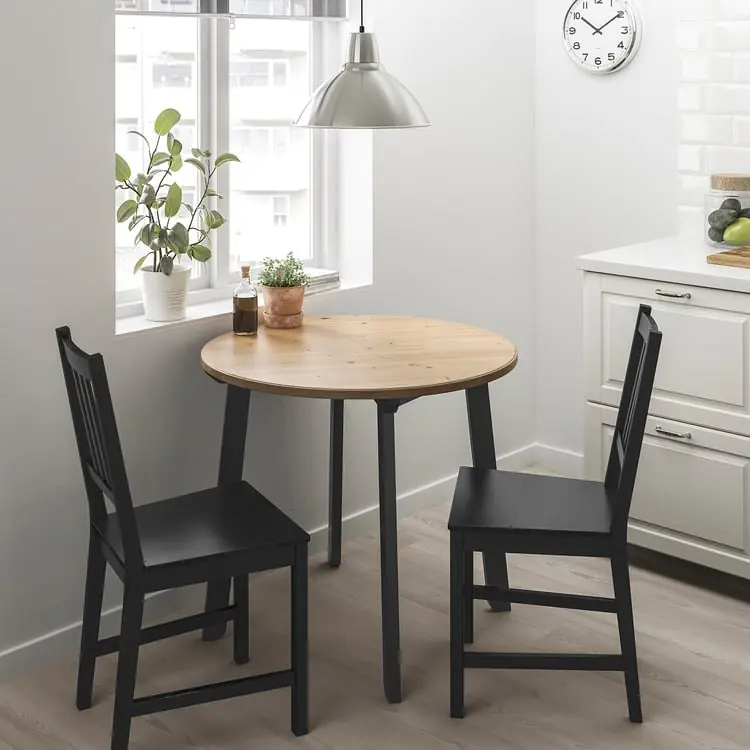
Check where each diner’s feet will go and how far the chairs project when occupied. A pedestal base can change those positions, but its feet can still obstruct a chair. Judge the actual base rather than assuming every round table creates the same seating space.
For an open-plan room, mark the neighboring seating area too. Our coffee table layout guide covers the separate reach and walking spaces around a sofa; avoid borrowing that floor area twice when drawing the dining nook.
An extendable table needs space during the changeover
A fixed footprint is straightforward until a larger meal needs more room. An extendable table offers another top size, but the changeover itself deserves a place on the plan. Ask where the tabletop sections move, where the leaf waits and whether the table must be moved away from the wall to open.
The GAPERHULT detail below shows a separate leaf above the opening and a metal sliding rail beneath it. IKEA lists an included extension leaf for this model. The photograph helps explain the parts involved; it does not establish how much force the mechanism needs or how well it will wear.
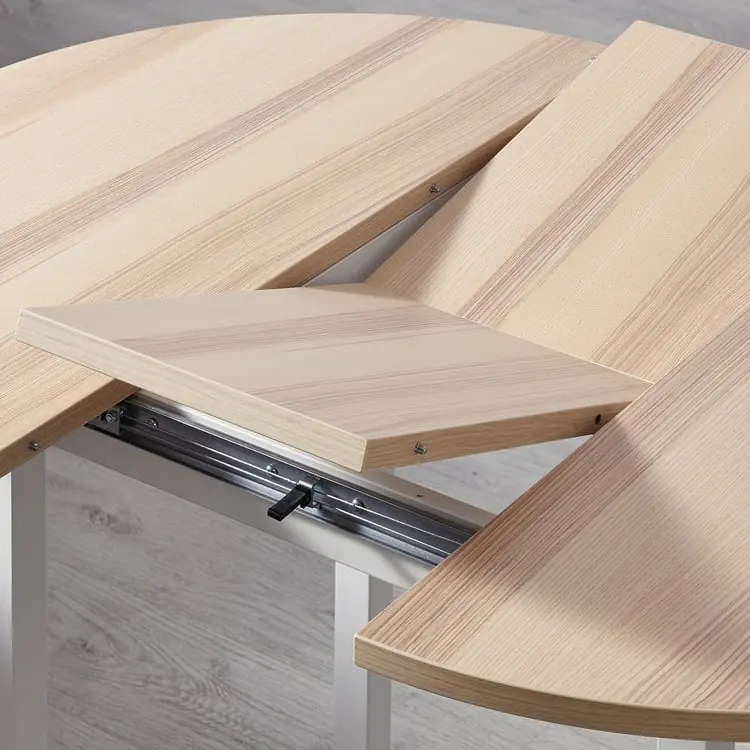
Check the manual for the exact opening sequence and any locking points. Ask for a demonstration if possible, especially if the table will be opened often. Compare the reach needed to handle the leaf with the place you expect the table to stand.
Confirm whether the leaf stores inside the table or elsewhere. A separate leaf needs an accessible storage position sized to the actual panel, and occasional chairs need somewhere to wait as well. The small-space storage guide helps compare usable storage dimensions and access before assigning that job to a cupboard.
Measure the dining area in its stored, seated and extended states
Once a format looks promising, test its changing footprint in the room. The following is a planning exercise for comparing candidates, rather than an assembly procedure or a universal clearance rule.
Mark the manufacturer’s closed tabletop outline with removable tape or paper suitable for the floor. Put your intended chairs in their parked positions, including any chairs stored elsewhere. Open nearby drawers and doors to see whether the smaller table actually returns the space you need.
Next, position the chairs as they would be during a meal. Measure the remaining gap from the back of an occupied chair to the nearest obstruction wherever someone needs to pass. Record that separately from the distance between the table edge and the wall; they describe different parts of the layout.
Finally, mark the fully open top and try the changeover space. Leave the extra chairs in their dining positions while someone walks the usual route and another person gets up. Use the household’s actual movements, including carrying dishes or using a mobility aid, to judge the space rather than treating an empty strip on the drawing as sufficient.
If dinner requires a cabinet to stay closed, decide whether that is acceptable occasionally. If the same cabinet must be reached throughout every meal, revisit the table size or position. A smaller daily top does not solve an extended layout that blocks essential access.
For a patio rather than an indoor nook, use the separate outdoor dining table guide, which also covers outdoor suitability and care.
Keep the dining table shortlist tied to everyday use
After the room test, compare the details that could change your choice: the closed and open dimensions, the base at each seat, the leaf arrangement, chair storage and the actual tabletop materials. Ask for missing measurements before ordering, along with the finish-care guidance and delivery requirements.
Favor the format whose smaller state earns its place. A drop-leaf table should return useful floor space; a round table should let the daily seating stay comfortably arranged; an extendable table should make a larger meal practical without turning every breakfast into a furniture-moving task. Keep the room sketch beside the product specifications, then explore more furniture and home guides at Wood Center.